CD Pipelines: Operational Control, Not a Delivery Convenience
Solve the right delivery problem

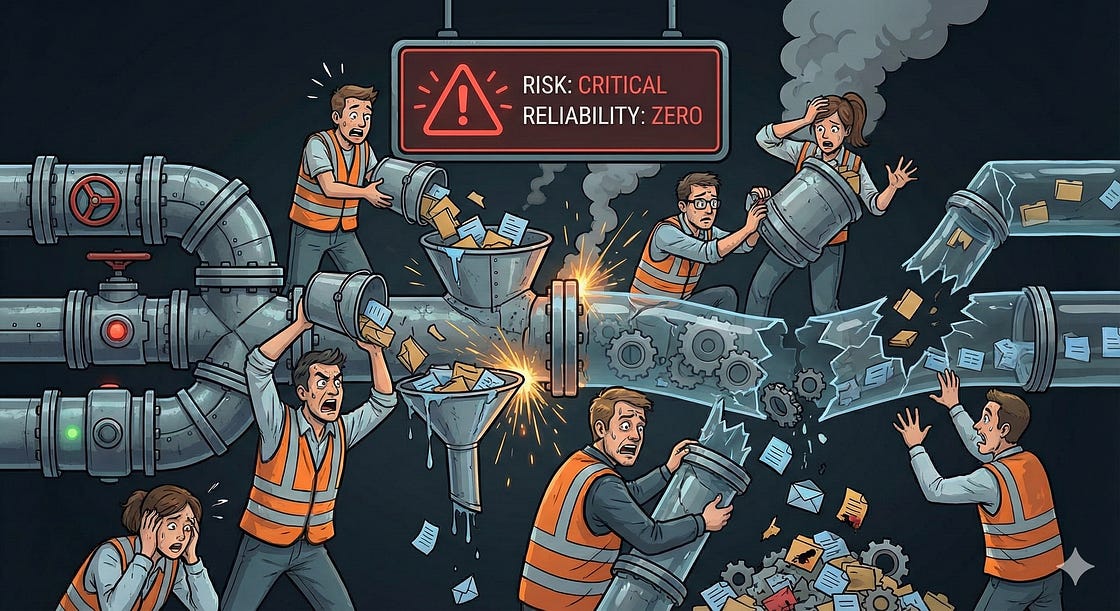
We need to stop talking about Continuous Delivery as a way to ship features faster. That mindset drives the wrong outcomes and entirely misses the point. It also causes some to believe that CD is only for “move fast and break things” development and should not be used for critical systems. That’s entirely wrong.
For systems that matter, CD pipelines are operational safety mechanisms. They exist to protect stability, enable rapid recovery, and enforce a defensible security posture. Speed is just a fortunate side effect.
If your pipeline cannot be trusted on demand, you don’t have a delivery system. You have a liability that just hasn’t been exercised under stress yet.
Stability Is Muscle Memory
In an incident, nobody rises to the level of their architecture diagrams. They fall to the level of their practiced execution.
This is where teams bleed. When production is on fire, panic sets in. Teams improvise new delivery processes on the fly. Tests get skipped “temporarily.” Security checks are bypassed “just this once.” Someone runs a script by hand that hasn’t been touched in six months.
Each decision feels reasonable in isolation. Together, they turn a bad situation into a prolonged outage.
A working CD pipeline provides a deterministic path from change to production. It replaces judgment calls with automated verification. It allows you to deploy fixes quickly without increasing risk. But this only works if the pipeline you use in an emergency is the same one you use on a quiet Tuesday.
If you can’t confidentially say, “We can deploy a fix right now using our normal process,” your operational risk is unacceptably high. You’ve just been lucky so far.
Pipelines Are Your Security Boundary
Security is the most difficult quality attribute because it doesn’t stay solved. It rots.
Performance problems announce themselves. Availability problems page you. Security problems sit quietly as the ground shifts beneath your assumptions. A dependency that was safe last quarter has a critical CVE today. A base image approved last year is now a supply-chain liability. Nothing in your system changed, but the risk did.
If you aren’t continuously re-validating your assumptions, you are already out of date; you just don’t know it yet.
This is why CD matters. The pipeline is the only place where security is enforced continuously rather than periodically. It is where dependencies are re-evaluated, policies are applied, and drift is detected before it becomes production reality. Anything outside the pipeline is guidance; the pipeline is enforcement.
The most dangerous security failures aren’t zero-days. They are stale guarantees. “We scanned that months ago” is not a defense.
When pipelines aren’t exercised regularly, security controls decay. Scans stop failing builds. Exceptions accumulate without ownership. Policies get loosened and never tightened. Eventually, teams stop trusting the signal. Security becomes theater: green dashboards backed by false confidence.
Green Pipelines Are Not a Vanity Metric
A green pipeline is not a badge of honor. It is a prerequisite for trust.
Red pipelines that stay red are telling you something critical: your feedback loop is broken. Tests are brittle. Environments aren’t reproducible. Ownership is unclear. Ignoring that signal is like driving with the check-engine light on and calling it “normal.”
Teams that take operations seriously treat pipeline health the same way they treat production health. Broken pipelines stop the line. Fixing them is priority zero. Feature work resumes only after confidence is restored.
You wouldn’t accept a production system that only works “most of the time.” Don’t accept it from the system that decides what is allowed into production.
Exercise It or Lose It
Pipelines degrade when they aren’t used. Credentials expire. Dependencies drift. Entropy sets in.
If you want a pipeline you can rely on in a crisis, you have to exercise it deliberately. This means deploying regularly, even if the changes are trivial. It means practicing rollbacks, not just forward motion. It means treating pipeline execution time as an operational constraint, not an inconvenience.
Think of it like a fire drill. You don’t want to discover the exits are blocked when the building is actually on fire.
Teams that only run pipelines for “major” releases are doing the opposite of risk management. They are optimizing for the quiet days and gambling on the loud ones.
CD Is How You Buy Down Risk
The real value of CD isn’t velocity. It is risk reduction.
Small, frequent, validated changes are easier to reason about, easier to secure, and easier to recover from. When something breaks — and it will — teams that practice CD don’t panic. Not because they are smarter, but because they have engineered a system where failure is survivable.
For critical systems, the ability to deploy safely is not optional. It is feature zero. Everything else depends on it.