Minimum CD New Trunk-Based Development Guide
The no-nonsense playbook for migrating to TBD without breaking your team.

Trunk-Based Development isn’t a religion. It’s a strategy for reducing the cost of change, improving feedback loops, and enabling continuous delivery. But for many teams, moving from long-lived branches to real integration still feels like tearing out plumbing in a house that’s already leaking. You know it needs to be done, but you also know there’s going to be a mess.
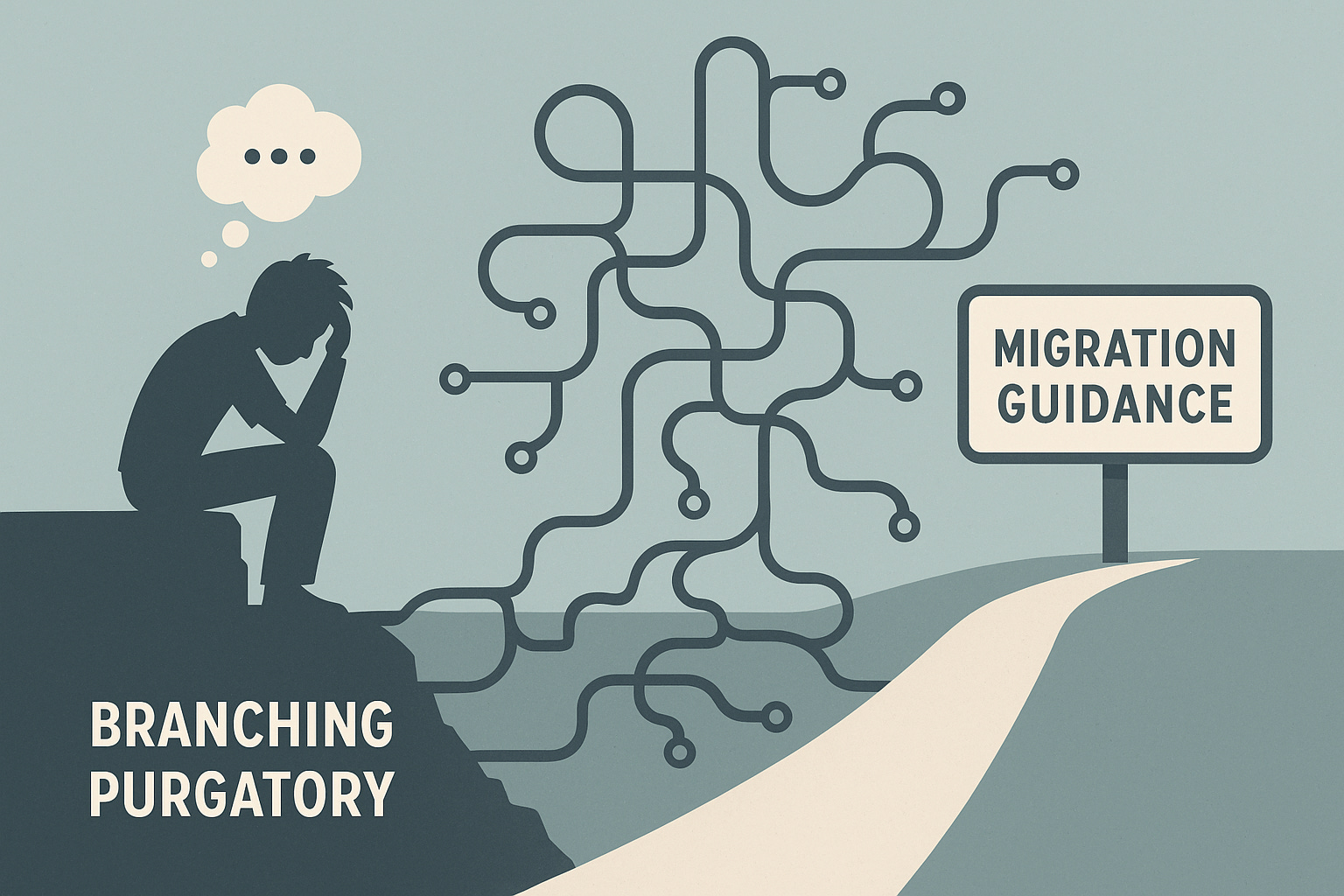
The new TBD Migration guidance on MinimumCD.org exists to make that mess smaller — and to help teams avoid the traps that keep them stuck in branching purgatory.
This isn’t a “just merge more” pep talk. It’s a practical playbook.
Why TBD Matters
Here’s the blunt truth: every day a branch lives, the cost of integration goes up. You don’t feel it at first… and then suddenly your “safe” workflow turns into a merge-conflict scrapyard, delivery slows, defects climb, and you start inventing complicated workflows to hide the pain. That’s exactly why MinimumCD calls out trunk-based development as a core expectation — because without fast integration, everything else in continuous delivery becomes harder and more expensive.
TBD isn’t about speed for speed’s sake. It’s about feedback. Until your code is in the trunk and running through the pipeline, you don’t know if you broke anything. Integrate early, integrate often, and the team learns faster.
What the New Guide Covers
The new content gives teams a step-by-step approach to get from “we merge when the feature is done” to “we integrate every day without drama.” Key points include:
How to slice work smaller so it can integrate without waiting for a full feature.
How to use feature flags effectively (hint: they’re about controlling release, not hiding untested work).
How to restructure team habits so integration becomes part of the daily flow rather than a special event.
How to make testing and pipelines support fast integration, not fight it.
Common migration pitfalls—like trying to adopt TBD without fixing story size or without team-level collaboration.
This isn’t theory. It’s the playbook teams have used in the real world to get from quarterly releases to daily delivery, often with the same people. No rockstars required — just discipline, clarity, and smaller batches.
Migration Is Less About Git and More About Behavior
The hardest part of TBD isn’t Git commands. It’s teaching teams to finish things together instead of starting things independently. It’s aligning on behaviors, acceptance criteria, and tests before coding begins, so integration doesn’t turn into a guessing game.
If your team struggles with large changes, endless merges, or code reviews that feel like archeology, TBD isn’t your enemy — it’s your way out.
Start Small, Then Shrink
If you’re considering the migration, here’s the mindset shift the guide reinforces:
Don’t wait until the system is “ready.” Migrate incrementally.
Deploy early, before features are complete. A dark release beats a surprise release.
Use the pipeline as the source of truth. If the pipeline can’t deploy it, it’s not done.
Focus on reducing the cost of change. Everything else — cadence, stability, morale — follows from that.
Teams that make the switch rarely want to go back. They discover that integration pain wasn’t a Git problem — it was a communication problem.
Check Out the Guide
If you’re serious about reducing drama, improving delivery stability, and moving closer to continuous delivery, the migration guide is worth your time. It takes the mystery out of TBD and replaces it with practical guidance you can start using today.